
In an age of digital noise, print is power
We are living through an unprecedented moment of digital saturation. The volume of content produced, published and consumed each day has grown to a scale that would have been unimaginable a decade ago, and artificial intelligence has accelerated that trajectory significantly. In this climate, the challenge for brands is no longer simply how to be seen, it’s how to be felt.
Across industries, algorithmic homogenisation has created a paradox: more content, less distinction. The more channels there are to communicate through, the harder it becomes to communicate anything that actually resonates. And in a category as sensory and emotionally charged as fragrance, the gap between what a brand wants to convey and what a digital feed can actually carry has never been more apparent.
This is why print is having a moment. Not out of nostalgia, and not as a rejection of the digital landscape, but as a strategic response to it. Physical materials offer something the scroll cannot replicate: presence, weight and the kind of brand authority that is experienced rather than scrolled past. In a crowded marketplace, the currency of print has quietly strengthened.
Across the fragrance industry, the houses leading this shift are building editorial worlds. Below, I examine how six of the most influential names in niche and luxury fragrance are using print to differentiate themselves, deepen brand storytelling and create the kind of lasting impression that no algorithm can manufacture.
“Print offers a different kind of brand authority. One that is felt, not scrolled.”
Byredo
Byredo has always understood that fragrance is not really about scent. It is about memory, atmosphere and the emotional residue of lived experience. Its approach to print reflects exactly that.
Alongside limited-edition books tied to projects such as Infra Luna and Bibliothèque, Byredo has released printed materials for launches including Mixed Emotions, Mumbai Noise and Eyes Closed, where campaign booklets and folded inserts render scent through photography, poetic fragments and typographic pacing rather than note pyramids. These publications foreground image sequencing, texture and negative space, allowing mood to lead interpretation rather than ingredient lists to dictate it.
In the case of Bibliothèque, the printed universe extends the idea of the private library into a tactile object, reinforcing the scent's intellectual and nostalgic framing in a way no homepage banner ever could.
This approach is formalised through Byredo Magazine, a recurring publication that positions the brand within a wider cultural and artistic context. Operating across fragrance, fashion and art, it uses print to consolidate a cross-disciplinary identity and to treat campaign materials as collectible objects rather than disposable collateral. The result is a brand that reinforces restraint and cultural credibility while maintaining strategic distance from the literalism and immediacy of digital marketing.
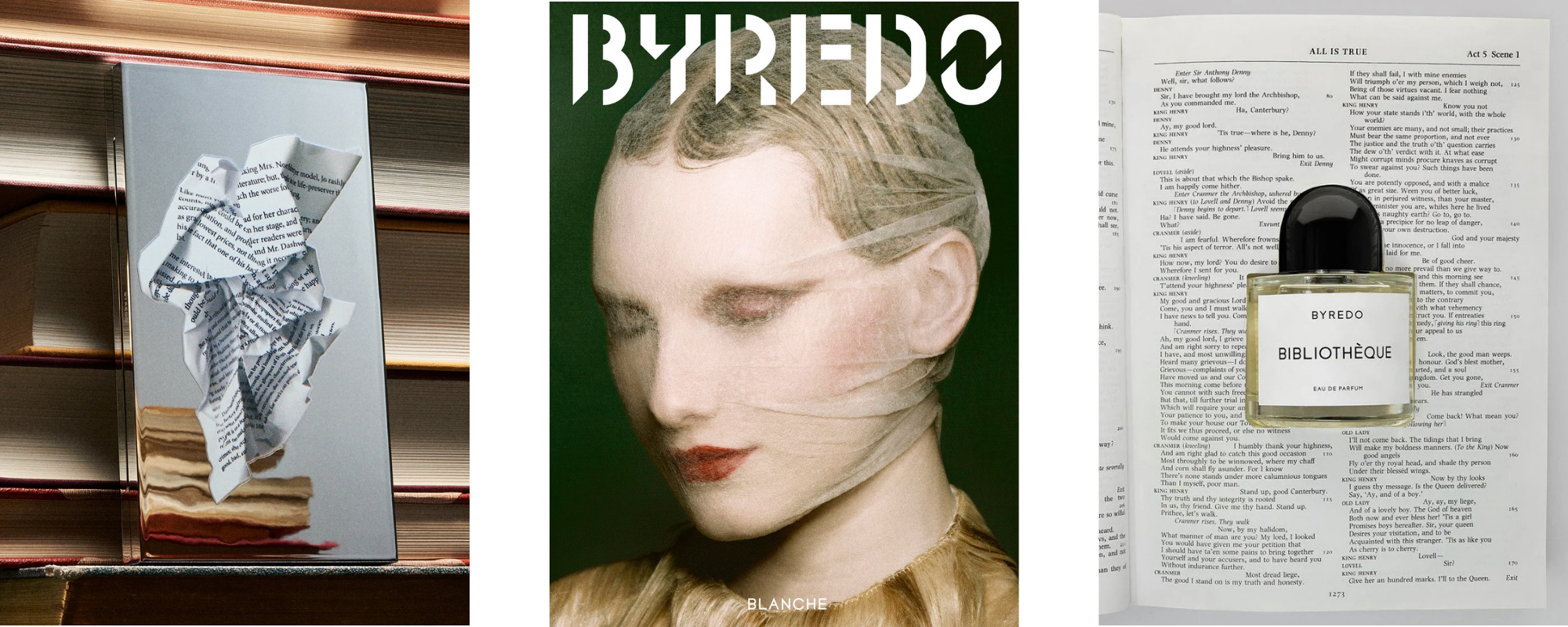
Image credit: Byredo
Le Labo
Le Labo's relationship with print is not decorative, it’s architectural. The brand's entire identity is grounded in typography, labelling and printed matter, and this commitment runs from the moment of purchase all the way through to city-specific retail collateral.
Its personalised bottle labels, printed in-store at the moment of purchase and stamped with city, date and name, transform packaging into personal documentation. Every bottle becomes a record. City-exclusive fragrances are accompanied by printed city guides and location-specific materials that reinforce locality as a physical, paper-based concept rather than a digital geotag. Le Journal, the brand's original-content broadsheet available both in-store and online, extends this system into editorial territory, combining cultural commentary with scent-driven perspective.
Even shipping boxes, ingredient lists and retail signage are typographic and text-forward, echoing laboratory forms and apothecary documentation. This analogue infrastructure operates as identity architecture rather than campaign support. It is not there to promote a particular product. It is there to hold the entire brand together in a coherent, tactile system.
In 2026, this disciplined commitment to print continues to differentiate Le Labo in a market increasingly defined by digital polish and interchangeable minimalism. When every brand looks broadly similar online, the brands that have invested in a physical identity system have a clear edge.
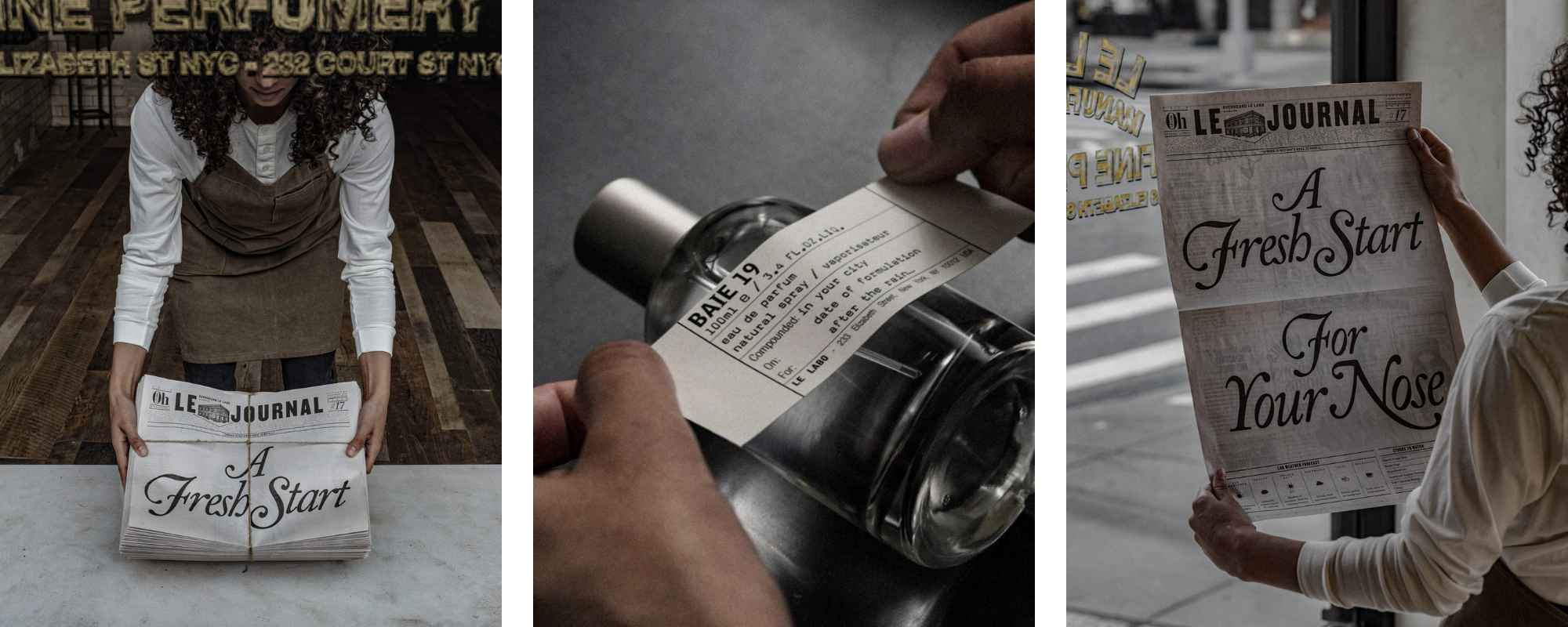
Image credit: Le Labo
D.S. & Durga
D.S. & Durga uses print as world-building. The brand, founded by David Seth Moltz and Kavi Moltz, has always been guided by a belief that scent is closer to music or literature than to beauty: it is something to be experienced, interpreted and contextualised.
Zine-like inserts, illustrated booklets and narrative-heavy campaign materials accompany launches. Each fragrance is supported by printed story cards written by co-founder David Seth Moltz, presenting fictionalised scenes, cultural references or imagined histories in place of technical note breakdowns. Select launches have been accompanied by newspaper-style materials and LP-sleeve-inspired designs that draw from music culture, pulp paperbacks and underground press aesthetics.
The founders' authorship remains visible in both copy and format. In doing so, the brand positions scent as a narrative object, reinforcing identity through storytelling rather than specification. There is no attempt to be authoritative or institutional; the brand is deliberately intimate, idiosyncratic and personal. And that quality of specificity is, paradoxically, what makes it so resonant.
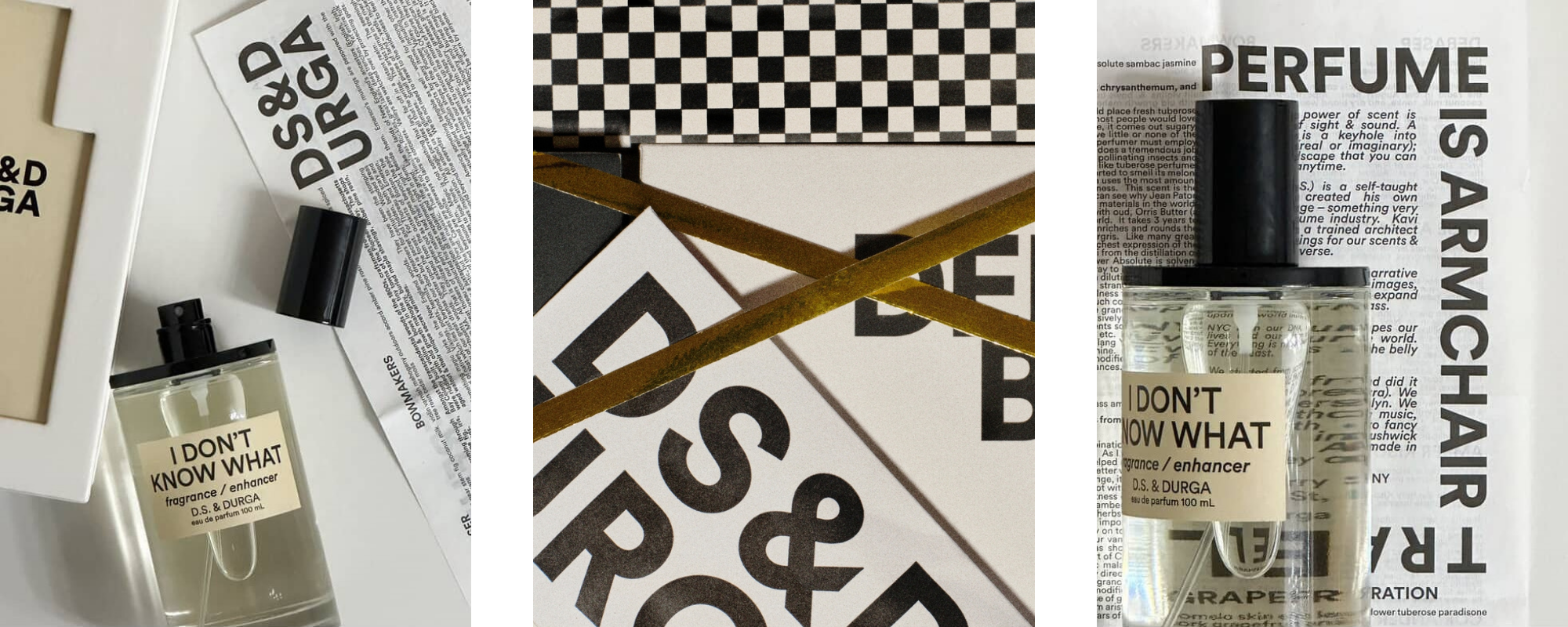
Image credit: D.S. & Durga
Maison Francis Kurkdjian
Maison Francis Kurkdjian's approach to print is more restrained than the brands above, but no less intentional. Where Byredo leans into mood and D.S. & Durga leans into narrative, MFK uses print to formalise heritage and to document craft.
The publication of Maison Francis Kurkdjian with Rizzoli in 2023 marked a pivotal moment, documenting Kurkdjian's compositional approach, raw material architecture and career trajectory in hardback form. Printed materials surrounding fragrances such as Baccarat Rouge 540 foreground the collaboration with Baccarat crystal manufacture, reinforcing craft dialogue rather than commercial success. Anniversary publications and retrospective materials further position Kurkdjian within the lineage of French perfumery, extending authorship beyond the brand itself.
This matters particularly in the context of acquisition. Print reinforces institutional legitimacy and stabilises a maison's identity as a house of perfumery rooted in method, discipline and long-term cultural relevance. When the market shifts, the archive holds.
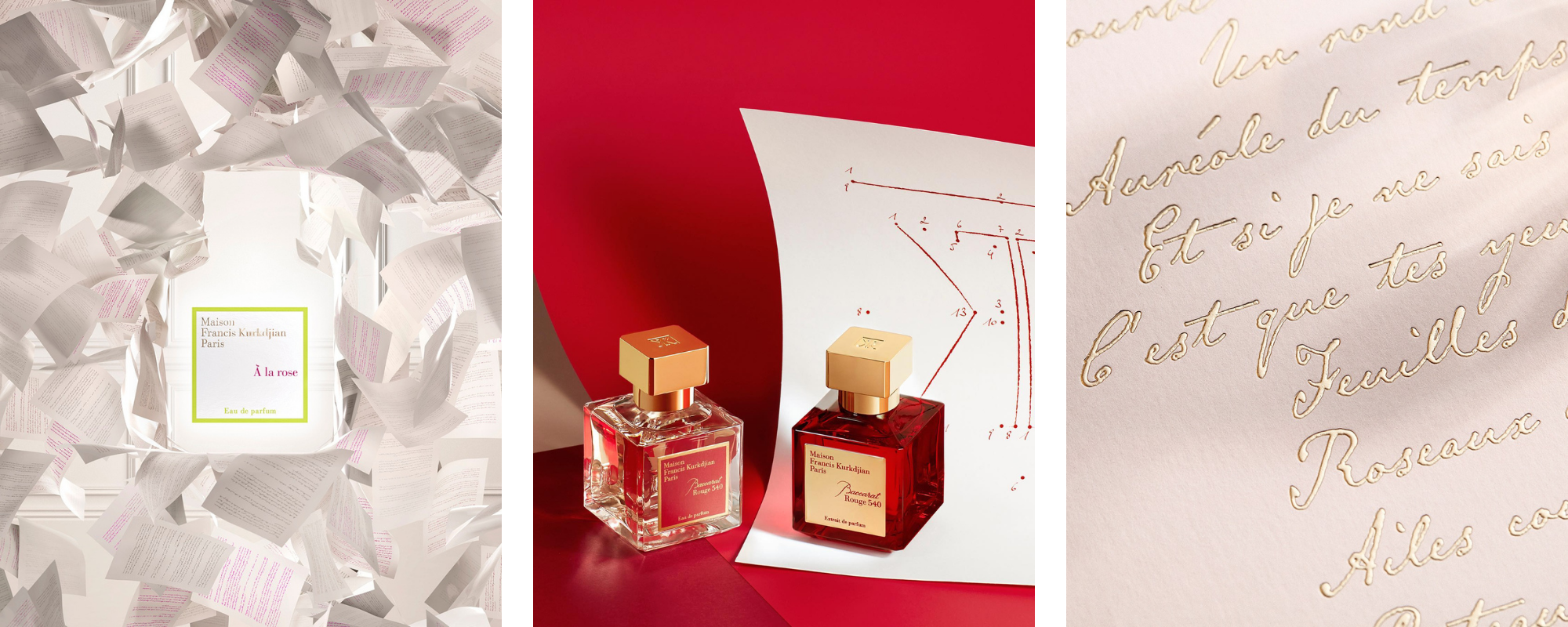
Image credit: Maison Francis Kurkdjian
Frederic Malle
Frederic Malle's entire model is built on the idea of the éditeur, and its print strategy makes that metaphor entirely literal. The house does not simply market fragrance; it publishes it. And the distinction matters enormously.
The publication of On Perfume Making in 2012 formalised this position, articulating Malle's philosophy and framing the perfumer as creative author rather than anonymous technician. In-store and online, fragrances are accompanied by printed interviews with their creators, extended explanatory texts and typographic panels that foreground composition, process and collaboration. Launch materials for scents such as Portrait of a Lady and Musc Ravageur have consistently centred the perfumer's voice in print, positioning the bottle as the outcome of authored work rather than manufactured product.
Even the name, Editions de Parfums, adopts the language of publishing. Print is not decorative collateral here but structural evidence of the editorial model itself. By documenting dialogue with perfumers in tangible form, the house situates fragrance within intellectual discourse and reinforces the claim that scent can be edited, commissioned and authored with the same rigour as literature.
It is a positioning that is remarkably difficult to replicate through digital channels alone. A perfumer's voice in print carries a different kind of authority to the same words on a product page. The format is the message.
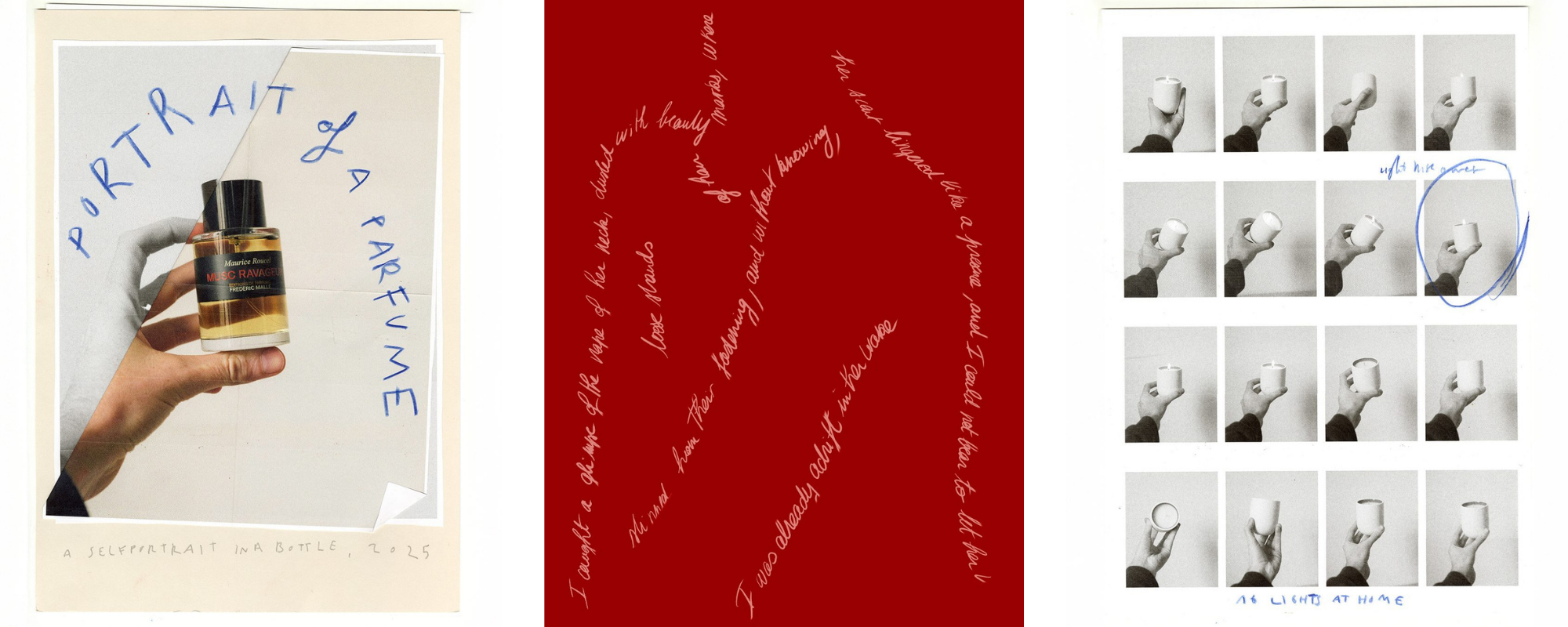
Image Credit: Frédéric Malle
Diptyque
Diptyque is, in many ways, the original case study for print as brand identity. Founded by artist-designers on Paris's Left Bank, the house has long treated illustration, typography and printed ephemera as core expressions of its identity. This graphic language extends beyond packaging into branded notebooks, planners and office accessories, where paper, print and desk rituals become part of the maison's creative universe.
This lineage was formalised in Diptyque: The Book (Rizzoli, 2021), which documented the brand's early textile work, graphic codes and artistic collaborations, positioning the maison within design history as much as fragrance history. From artist-led limited editions accompanied by illustrated booklets to anniversary and exhibition catalogues that archive travel narratives and botanical inspirations, Diptyque consistently translates scent into print culture.
Rooted in drawing, literature and travel, publishing feels intrinsic rather than opportunistic for Diptyque. And that distinction matters enormously: print that emerges organically from a brand's founding values carries a very different weight to print that is bolted on as a marketing initiative. The former reinforces continuity and artistic authorship as the brand scales globally. The latter tends to feel exactly like what it is.
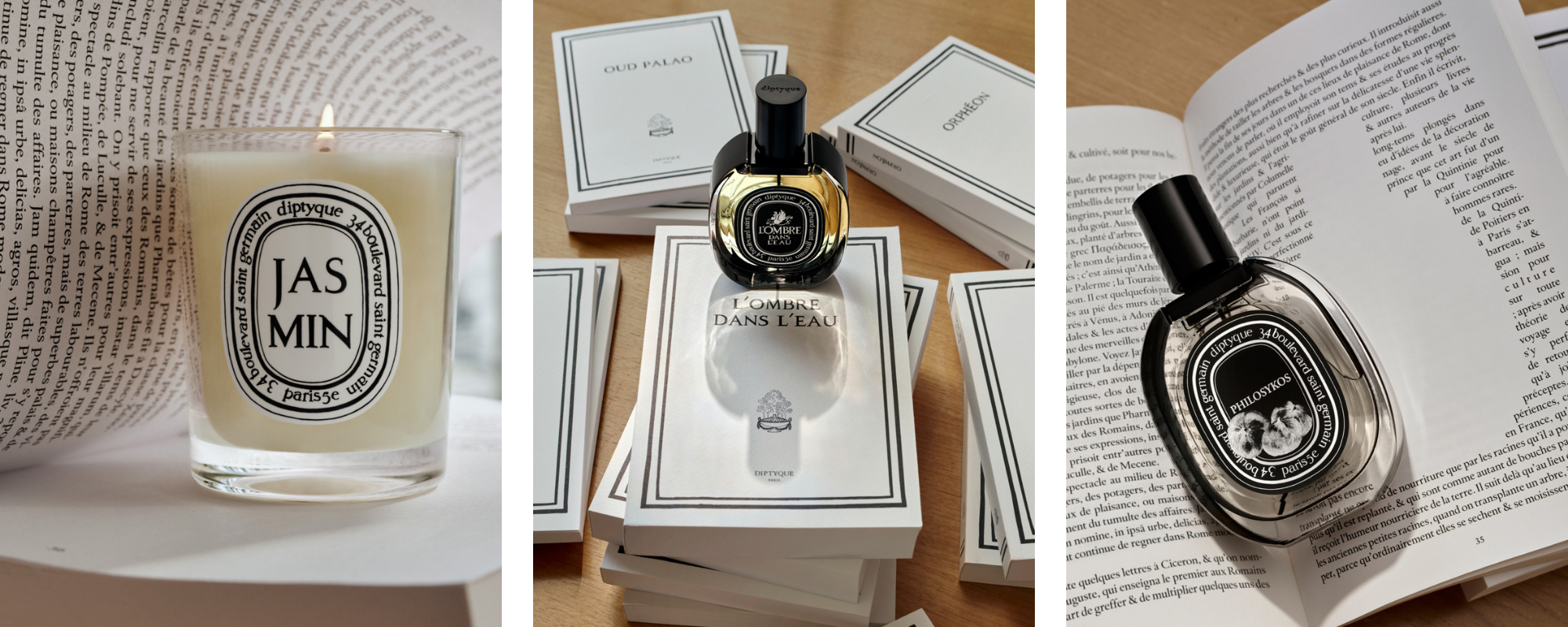
Image credit: Diptyque
What the best fragrance brands know about print that most are still figuring out
Print is not the opposite of digital. The six fragrance houses examined here are not rejecting one medium in favour of another. They are using print to do something digital cannot: to create an experience of brand that is physical, deliberate and slow.
In fragrance, slowness is not a weakness. The category is built on the idea that meaning accumulates over time, that a scent reveals itself gradually, that memory and sensation are inseparable. Print, at its best, operates on exactly the same logic. It asks the customer to stop, to hold something, to read. And in doing so, it creates a different kind of relationship between brand and audience.
The fragrance brands investing in print in 2026 are not doing so because it is nostalgic or contrarian. They are doing so because they understand that brand authority in a saturated market is not won through volume. It is won through conviction. And there is no more convincing expression of conviction than something you can hold in your hands.
“Brand authority in a saturated market is not won through volume. It is won through conviction.”
If you are working on brand strategy, verbal identity or editorial content and would like to explore what print could do for your brand, please get in touch.
sophie@thebespokeword.com
